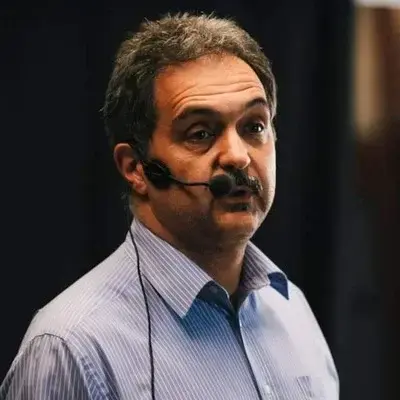
End of May, I attended the TNG Big Tech Day (https://www.bigtechday.com/). TNG describes it as “a one-day conference on science and technology, with a focus on IT. The speakers often come from the field of information technology, but some also come from other scientific disciplines such as physics, mathematics, or mechanical engineering”.
It’s a fairly large conference with about 2000 attendees. As usual there were multiple tracks, so it’s always hard to decide. But maybe the will also publish some of the talks later on as recordings.
I chose most of my talks from the AI track and wanted to share my thoughts. The summaries of the talks can be found online so I won’t repeat them here.
AI for Humans
https://www.bigtechday.com/vortraege#33ST2mGCEKRL00NHjiXfjQ
Gregor Schmalzried:
https://www.bigtechday.com/speaker#4bU5a1LFwLeKPPU4qFJQHB
https://www.linkedin.com/in/gregorschmalzried/
Der Ki Podcast: https://www.ardsounds.de/sendung/der-ki-podcast/urn:ard:show:65505255c703e51e/
The talk was inspiring as expected, if you know Gregor’s Podcast. Gregor showed the differences and advancements from a couple of years ago, how he uses agents and why we find things odd.
An interesting statistics he showed was that in almost all countries about 20-30% of the people like AI but also 20-30% dislike it (with stronger sentiments in the UK and the US if I remember correctly). – Well given what we see in the press coverage about AI, no one is surprised about the negative feelings.
But still, Gregor sees a good future if we manage to leverage AI for mor good things. Honestly: I’m not so positive, but I’d be happy to be proven wrong.
How to OWN the AI – Building a custom AI workmate for Bank Frick
https://www.bigtechday.com/vortraege#1UieGaHyAPaMR39LGgkGXN
The team showed how Bank Frick (https://www.bankfrick.li) developed their own chat & agent framework which is now used by more than 120 of their ~300 employees. I liked the approach as they showed how they executed several use cases but always kept track of the business impact and some key metrics to measure the benefit of the solution.
I asked how long it took to develop the solution so far. If I remember correctly, it was developed by about 3 people for like 5 months. The development is now handed over to an internal team.
Regarding my rough estimation for the cost of the initial build (excluding infrastructure cost) plus further development internally … I’m wondering, if in 2026, there aren’t already some off-the-shelf solutions that might have lower cost (for the price of some dependency). But I’m sure they do/did that evaluation.
Lessons from the bleeding edge of AI/ML security
https://www.bigtechday.com/vortraege#6mEhk9SpfhzKaRIDmlhAZi
Keith Hoodlet
https://securing.dev/
https://www.linkedin.com/in/securingdev/
@securingdev@infosec.exchange
Keith Hoodlet from 1Password showed the current state of security requirements when using AI / LLMs. From prompt-injection and the threats when Agents act on behalf of the user and how much AI has reduced the time from “disclosure” to “attack”. Honestly, after the talk, you don’t necessarily feel more secure than before. – Like after any security talk one attends. I liked the proposals he showed to make agents secure. But I wonder how many companies invest so much to make such a secure environment.
I also like how Keith mentioned that AI in general might be controversial, but we have to accept that it’s there and that attackers do use it. So we have to prepare for it.
I’m not sure if it was Keith’s talk or another. But I think he also mentioned the issue of vibe coded apps in enterprises (“Vibe coded” here used as a separation to “agentic engineering”, the former is more the quick and dirty, the latter with engineering, security etc in mind): Let’s face it, these vibe coded apps exist and the trend might not vanish. Yet, those applications also MUST obey to some standard company SDLC to not expose risks. The challenge will be, how to enforce that …
Who reviews the agent? From IDE assistants to OpenClaw
https://www.bigtechday.com/vortraege#4OsB6zRo4FA3VY6YuqhyGg
Marius Wichtner
https://www.wichtner.com/
https://kilo.ai
Marius showed kilo.ai, an agentic coding platform. How the agents write and test code. What this means for us developers and how agents can/should be leveraged. In fact I found kilo.ai really interesting. I didn’t know it before, maybe I’ll give it a try for some tests. One thing that I find still amazing, is the approach to let several agents implement a feature (maybe if you don’t exactly know how a UI should look like), review and compare the solutions and then decide for one of the solutions. Of course, it comes with token costs, but that’s the price to have a choice.
Another interesting point he made was, that people who currently lead others (group leads, lead developers) are those who perform best when working with multiple agents as they know how to (communicate &) delegate so that other people know what is expected. What a “surprise”, communication is key – still.
Btw: Marius said, yes in the end, YOU will review the code.
Get comfortable being uncomfortable: The Great Pacific Escapade
https://www.bigtechday.com/vortraege#6KYPOBatZvQU398UUFUhr3
TNG Big Tech Day wouldn’t be the BigTechDay if there were no inspiring sports-talks! I heard so much about AI that I needed something else for a bit. Attending the talk of Jessica and Miriam was definitely something else. The two women rowed(!) their boat 165 days over 8,213 nautical miles (15.212 km) from Peru, South America to Cairns, Australia – non-stop and unsupported.
There were quite a couple of “omg” and “wow” moments during the talk. Just thinking about rowing 15h a day – every day, having to filter your water each and every day (and the water filter breaking), cleaning the hull every 4 days from molluscs, rowing in hailstorms, navigating, being alone for half a year and burning over 5,000 calories each day. And all this in such a small boat. And besides surviving and rowing, they also had to household with their electronics and solar-charging to navigate, but also satisfy sponsors by creating some content.
The whole talk was a testament what we can achieve with an according mindset, the will to continue and to tackle challenges.
2 Million Dollars worth of code for $20,000: Rewriting large software projects with AI agents
https://www.bigtechday.com/vortraege#1ckBbBfvwisPk3PzQoQneD
“Rewriting a behemoth” is a story that every developer has heard in his life. That’s why I wanted to attend that talk, too. Rewriting about 60,000 Lines of code usually would account for 7 digits budgets and quite a time. The two did it in 3 weeks and 20,000 $ token budget.
BUT it was was quite impressive how much effort they still had to put into it! If you think it’s just firing up Claude Code and say “rewrite” .. you couldn’t be more wrong. Especially as they tried in early 2025 and had to freeze the project and restart in 2026 as the models weren’t good enough a year ago and had become so much better. And still it did sound like so much engineering effort that went into this setup! Pretty wow.
But – in contrast to the talk to talk “Who reviews the Agent”, the two decided that no human reviews the code any more. They had to trade velocity over safety. That’s quite a statement that needs to settle in the mind. – But still, agentic engineering could indeed be a way out of the problem of big legacy systems where you simply cannot afford multi year rewrites.
Summary
As expected, the TechDay was loaded with impressive talks and insights. Also the conversations in the coffee breaks were pretty precious. The AI topic was quite overwhelming (well I only attended the AI track) in all the varieties.
One thing that I really appreciated, was that AI wasn’t just presented as a silver bullet. From threat modelling that just shows the dark side – to the impressive agentic engineering talks that show how much software engineering is involved to succeed.
But also the conversations in the coffee breaks were precious that connected back to Gregor Schmalzried’s talk (reproduced from my mind) “About 20–30% are against AI. Well, no wonder! We (ordinary people) hardly see any benefits from it. Instead, we can’t trust any videos anymore, computers are expensive, and nuclear power plants are being built for this. – And this so-called increase in efficiency – where is it? Whome exactly does it help? Not me. It’s just leading to layoffs“.
But AI is definitely in our (developers’) lives. Whether we like it or not. Especially the “rewriting legacy” problem is a very interesting one that could add benefit. But what it all means for us? I don’t know. The pricing will be a corner stone for the further development. Interesting times are ahead of us, for sure.
And if you couldn’t attend, watch out for the recordings on https://www.bigtechday.com/rueckblick and the YouTube channel https://www.youtube.com/@tngtech/playlists.